On my way home from work last night, the unmistakable call of the Pacific koel echoed around the carpark. It was just after 17:30 pm, and there were two birds involved in the distinct calls.
Again, this is my first observation of the species in the lower Hunter Valley for Spring 2017, and only important as an anecdotal observation - they are migratory and arrive and disappear roughly the same time every year.
See these posts from last year - "The Cuckoos have arrived" and "The Eastern koels have finally reached Belmont..." . The Channel-bills arrived on 29th Sept 2017 and the Koels on 1st October 2016.
It seems that Spring truly is a little early this year. The Australian raven that I saw carrying nesting material back on 13th of July 2017 was the first indication. I wonder if the early nesting from the Australian raven is a strategy to help minimise the risk of nest parasitism by the Channel-bills & Koels? As always, more observations are needed before this might hypothesise a deliberate strategy. One anecdote is merely one anecdote - nothing more.
Wednesday, 20 September 2017

Tuesday, 19 September 2017
The Channel-billed cuckoos are back
A mate and I were fishing in my little boat off Carey Bay on Lake Macquarie on Sunday morning, 17th September 2017. We both heard the unmistakable, shrill call of a Channel-billed cuckoo echoing around the bay. It was 8:20 am and conditions were still and calm. There was not a cloud in the sky, no wind, but we could not see the bird to get a definite, visual identification. However their call is absolutely unmistakable. This was my first record of Channel-bills for Spring 2017.
Looking back over my records, last year I first heard them on Sunday 25th September - in very similar circumstances. Again, weather is obviously changing, the days are slowly getting longer, and the cuckoos are back. The Koels should be here too - I'll have to keep an ear open for them.
I have recorded this sighting with the Atlas of Living Australia.
Monday, 21 August 2017
New species for Casa da Ayre - Buff-banded rail
Something caught my eye in our backyard this morning - it was through the drapes and it wasn't a clear sighting, but it instantly caught my attention. It looked like a small swamp-hen, but it clearly wasn't - the colour was all wrong.
I opened the drapes and at ten metres range, watched a Buff-banded rail foraging across the backyard for about thirty seconds. I left to grab my camera and of course it was gone when I returned, so there is no photographic evidence. But I had a very clear view and 100% confident in my identification. Hopefully I'll get a photo in the near future.
Thursday, 13 July 2017
Watchout Jon Snow - Spring is coming . . .
It's the very middle of the Australian Winter as I write this, 13th of July 2017, and I noticed the first harbinger of Spring 2017 on my morning commute today.
An Australian raven flew low over the Hillsborough Road overpass just ahead of my car, and I couldn't help but see it was carrying a large stick in it's bill. The days are getting noticeably longer - Spring might be early again this year.
An Australian raven flew low over the Hillsborough Road overpass just ahead of my car, and I couldn't help but see it was carrying a large stick in it's bill. The days are getting noticeably longer - Spring might be early again this year.
Saturday, 27 May 2017
Another endangered species sighting - Jabiru aka "Black-necked stork"
 |
| Jabiru, aka "Black-necked stork" near Maitland NSW 25th May 2017 |
Well, here's something to get you excited ! On my way to work this morning I observed a (probably male) Jabiru. This is an interesting sighting, because it's the first time I have ever seen a totally wild Jabiru in the Hunter Valley, and I was fortunate enough to have my camera with me at the time. I believe the bird is male because the initial sighting was at 200 metres range, and through my camera his eye appeared brown, not the obvious bright yellow of the female.
The Jabiru is secure in Australia - in fact when I lived in Darwin they were a pretty common sight on the flood plains. However the further south you go, the progressively less common this species becomes. Thus it is NOT listed under the Commonwealth Environment Protection and Biodiversity Conservation Act 1999 (EPBC Act), but it IS listed as Endangered under the NSW Threatened Species Conservation Act 1995.
 |
| Jabiru being harassed by a Black-shouldered kite, near Maitland NSW. |
I have driven the back roads on my way to work as much as I possibly can to avoid the traffic, and because I love the unusual things you see in the out of the way places. A few years back I saw Freckled ducks. A few months ago I found a Peregrine falcon on the road, surrounded by unmistakable pink-coloured Galah feathers, just killed by a car ahead of me. And now on one of my trips along the back roads, I have observed my first wild Jabiru in NSW. Fantastic stuff ! If you look closely at the photos you will see the Jabiru was being shadowed by a Black-shouldered kite, a small elegant hawk. The Kite shadowed the Jabiru at a respectful distance, never getting too close, but letting the larger bird know it was trespassing. In the background you can see exactly WHY the Jabiru is now considered endangered in NSW - new McMansions built up right to the very edge of the flood plains the Jabiru requires to forage and breed. From my time in the NT, it appears that Jabirus do not seem to like associating near humans - and they tended not to breed anywhere near humans.
If you'd like to know a bit more about them, have a look at these pages;
A bit of an aside - I call this species "Jabiru" for the same reason I call Blue wrens, Blue wrens and not "Blue fairy-wrens". Simply because I have never met a normal person call a Blue wren a "Fairy-wren". The birdos claim the Jabiru should be called "Black-necked stork", (or abbreviated to BNS) because its the only species of true stork found in Australia. This is true that Jabirus are Australia's only stork, but the only people I have ever known to call this species a "BNS" are birdos, or "twitchers" as they like to call themselves.
BNS is a stupid "common name" in my humble opinion because only twitchers use it and when you look at a Jabiru, their neck is the most impossibly glorious metallic blue-green you have ever seen in your life. They shimmer like a vision in the sun! The only time their neck is black is from great distance, or if it's very poor light. Jabiru it shall always be for me.
Monday, 13 March 2017
The Sounds of Autumn . . .
The glorious warbling carols of a Pied butcherbird made my heart soar this morning. I have no idea why, but there are few things more likely to make me smile when I'm reading the newspaper over my morning coffee. It's like the arrival of the Channel-billed cuckoos, the Dollarbirds and the Koels. The seasons are ever-changing, and the first heralds of Autumn in my part of South-eastern Australia have arrived.
Sunday, 19 February 2017
Night of Nights . . .
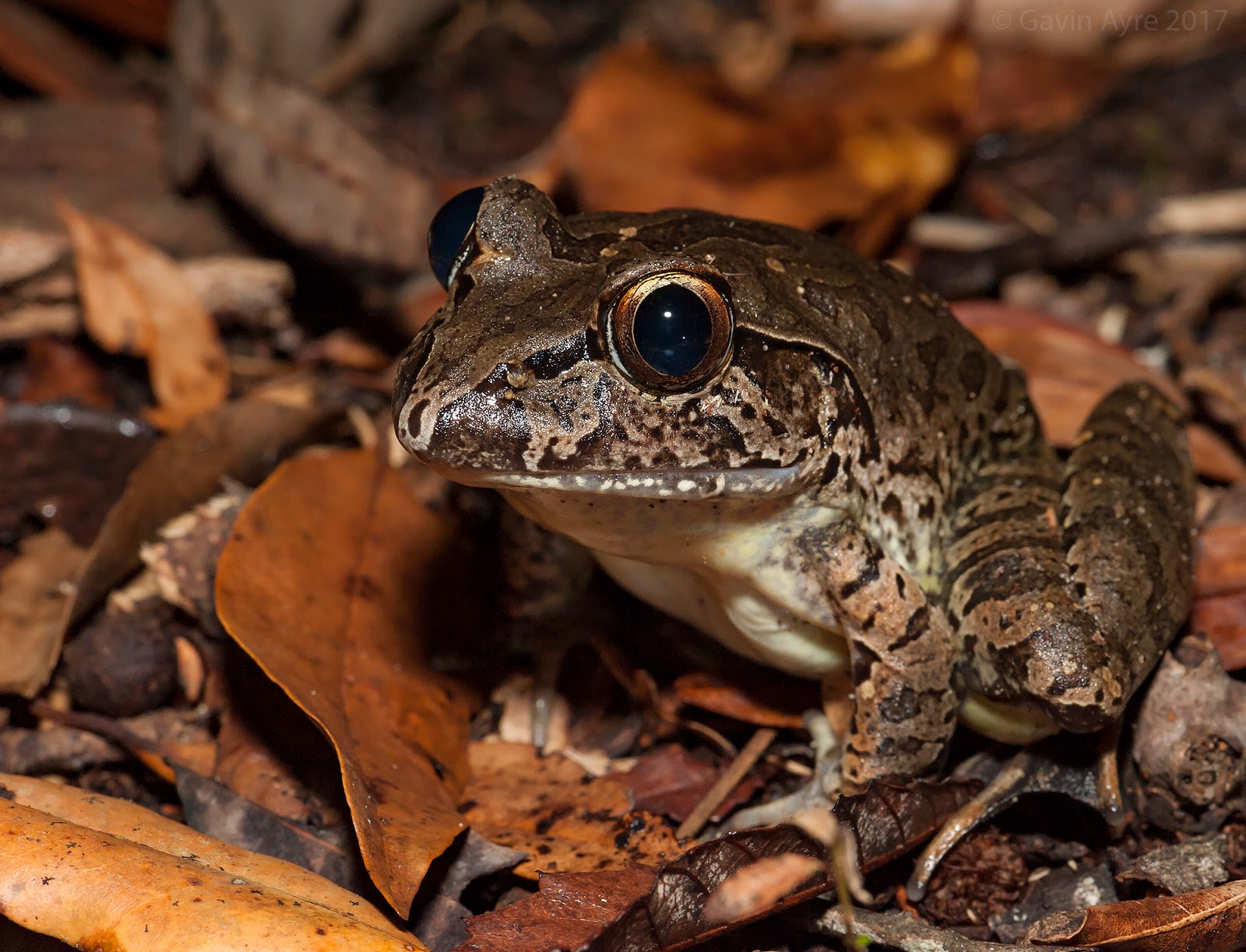 |
| Be still my pounding heart ! A truly magnificent adult Mixophyes iteratus |
What a night it was. The highlight was encountering a major breeding event for the endangered Giant barred frog, Mixophyes iteratus. As mentioned in a previous past, this species was utterly devastated (presumably) by Chytrid fungus, and in all my years of working locally in the forests of the Hunter valley and Manning Valley, I'd only encountered ONE specimen. Until Saturday 11th February that was when I found a second specimen in a completely new location.
Well, I visited an unpublished site for M.iteratus that I know of, deep in the rainforest, from my time working with the Amphibian Research Group at the Uni of Newcastle. It was a spectacular night, the stuff of pure fantasy, with Mixophyes iteratus calling all around us. It was reminiscent of my trip with Mike Mahony to a location well to the north of Newcastle where there was roughly a kilometre of M.iteratus calling and echoing along the banks of a rainforest stream.
On Friday night, I actually stopped counting after 20 individuals. They were literally everywhere. I took a few representative images, taking great care not to touch or disturb the animals, and quickly left them to their business. The last thing we were going to do was interfere with an endangered animal in any way, particularly when they were in the middle of a massive breeding event.
Yesterday I discussed the event with one of my contacts in the Amphibian Research Group at the University of Newcastle, and he knew the species has definitely made a comeback. But he was utterly shocked at the size of the breeding event we'd encountered. Sounds like the old crew (and some new members) might be working on this species again soon !
 |
| Mixophyes iteratus |
 |
| Very large female Mixophyes iteratus |
Subscribe to:
Posts (Atom)